
CIVIL SERVICE WITNESSES: PIETRO PIO'S STORY
“Educating to heal the colonial wound”, by Pietro Pio Annunziata, Servizio Civile Universale, Quito (Ecuador)
Through what lens do we view the world around us? How much does this influence the way we experience it? Are we sure that knowledge, historical memory, and time itself are objective and linear? I have been living in Quito, Ecuador, for a few months now, working as a civil service volunteer. My job is to teach English at the Yachay Wasi school, a name that translates from Kichwa as “House of Knowledge.”
The school is part of the intercultural bilingual education system, a sector of the Ecuadorian Ministry of Education that arose from the political demands of the large indigenous mobilizations of the 1990s. Here, the peoples demanded recognition of their right to learn in their own language, in an ecosystem that respected the values of their ancestral culture and did not relegate them to a position of inferiority or mere superstition.
About thirty years ago, Yachay Wasi was transformed into an environment that, in all its forms, is constantly searching for a different educational model, one that embraces ancestral culture without denying the modern West, and does so in a context where indigenous resistance can be transformed into an intersectional and universal struggle.
Laura Santillán and Fernando Chimba, the founders of the escuelita, and now its director Ninari Chimba, have developed their own teaching method, called “Ishkay Yachay,” from the Kichwa phrase meaning “the two wisdoms.” Based on the teachings of great indigenous pioneers such as Dolores Cacuango and Transito Amaguaña, the goal of Ishkay Yachay is to perfectly align traditional Andean-Amazonian-Afro ethnoscience with modern Western knowledge, with the ultimate aim of healing the deep colonial wound that this land has sadly inherited.
Teaching in the escuelita translates into a constant epistemic contrast: it is our duty to teach children that these two universes of knowledge, although very different, coexist and are part of the complexity of a world that would be too reductive to analyze from a single perspective, despite the fact that this tactic has been, and continues to be, a powerful weapon of colonialism.
Explaining colors, even just to translate them into English, means explaining that, on one side of the planet, they are considered waves, reflections of light that our eyes decode through chemical reactions, but that in the historical memory of this land, they are the living language of Pachamama, mother of time and space, signs through which she tells us that it is about to rain, that she will soon give us fruit, or that she needs care.
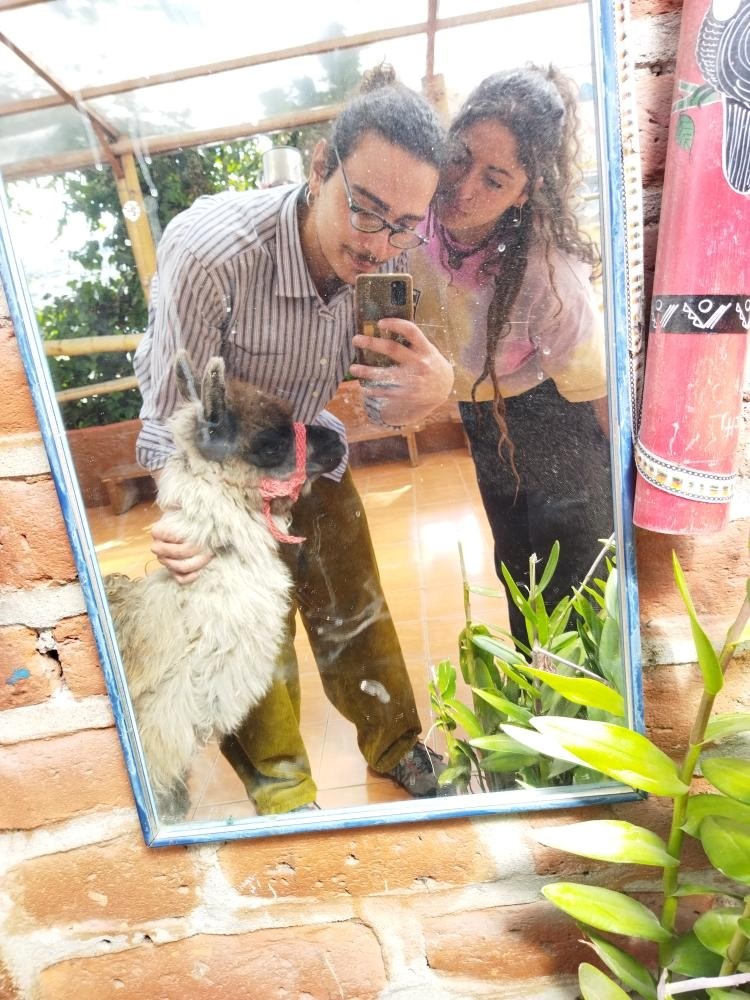
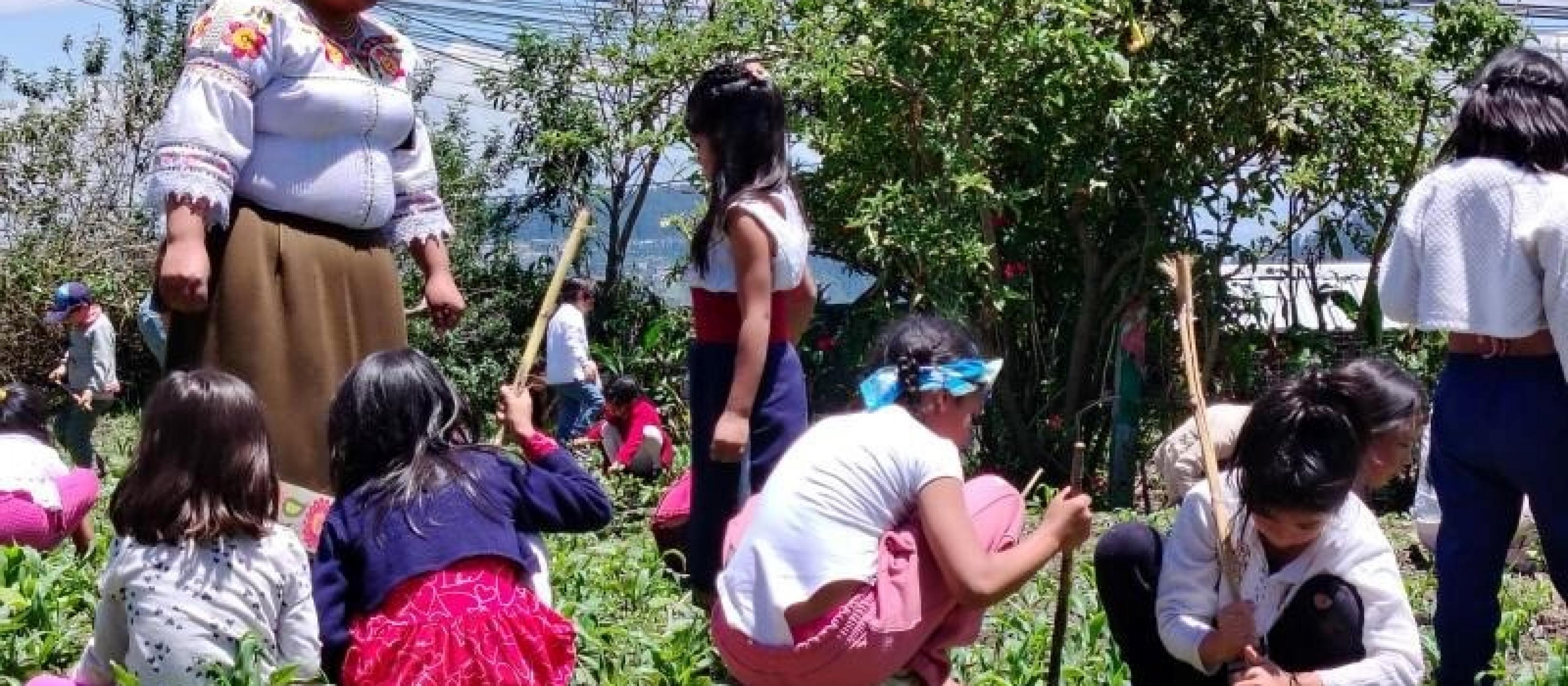
In this context, a fundamental principle of the philosophy is that of “Mutual Care.” Deconstructing anthropocentrism, a direct reflection of Eurocentrism, schools teach that every actor in nature has equal dignity, and that caring for them means allowing them, one day, to care for us, and not only in a material or nutritional sense. Pachamama brings with it complex and profound teachings about love, affection, loyalty, and, above all, resilience. Thus, we ask permission from every plant before drawing it or even touching it. Our little dog Kushi, from the Kichwa word for ‘happy’, and the llamas Rufo and Mashita teach us about resilience, and natural phenomena become a starting point for reflecting on politics and the cycle of non-linear time (the Pachakutik), marked by an agricultural calendar made up of sowing and harvesting rituals.
Pachamama also teaches us to rediscover the “feminine” in everything, in a deeply anti-patriarchal vision, as is the Kichwa language itself, which knows no gender declension. The children of the escuelita, aged 3 to 13, all know how to recognize the systems of oppression to which the world is subject, in an education that, as the mural on the school facade says, is for social justice, ecological justice, linguistic justice, and spiritual justice.
Ishkay Yachay is based on these pillars, and it is on these pillars that I find my role in this part of the world, my purpose. Working at Yachay Wasi means living, with my body, in an environment that breathes affection and awareness. A world that, although distant from me, is the same one I have always inhabited, and which allows me to completely redefine the values of care, symbiosis with nature, and memory.
A world that makes me understand that teaching political awareness and emotional intelligence at school is not sacrilegious, that a different kind of education exists and that, in fact, when it is openly anti-racist, anti-capitalist, anti-patriarchal, and decolonial, it becomes a powerful tool. A world in which it is also my privilege, in a vision that is universal rather than exclusive, to cultivate hope and change, to be a seed.
This is only a small part of the layered pedagogy I am being taught here. The first big impact for me was hearing the children call their teachers, myself included, “mashi,” from the Kichwa word for “companion.” I hope that, even at the end of this experience, Yachay Wasi and its inhabitants will continue to flourish within me, that their resilient fruits will become my lens, and that I will always be, in whatever form, mashi Pietro. Yupaychanchik.